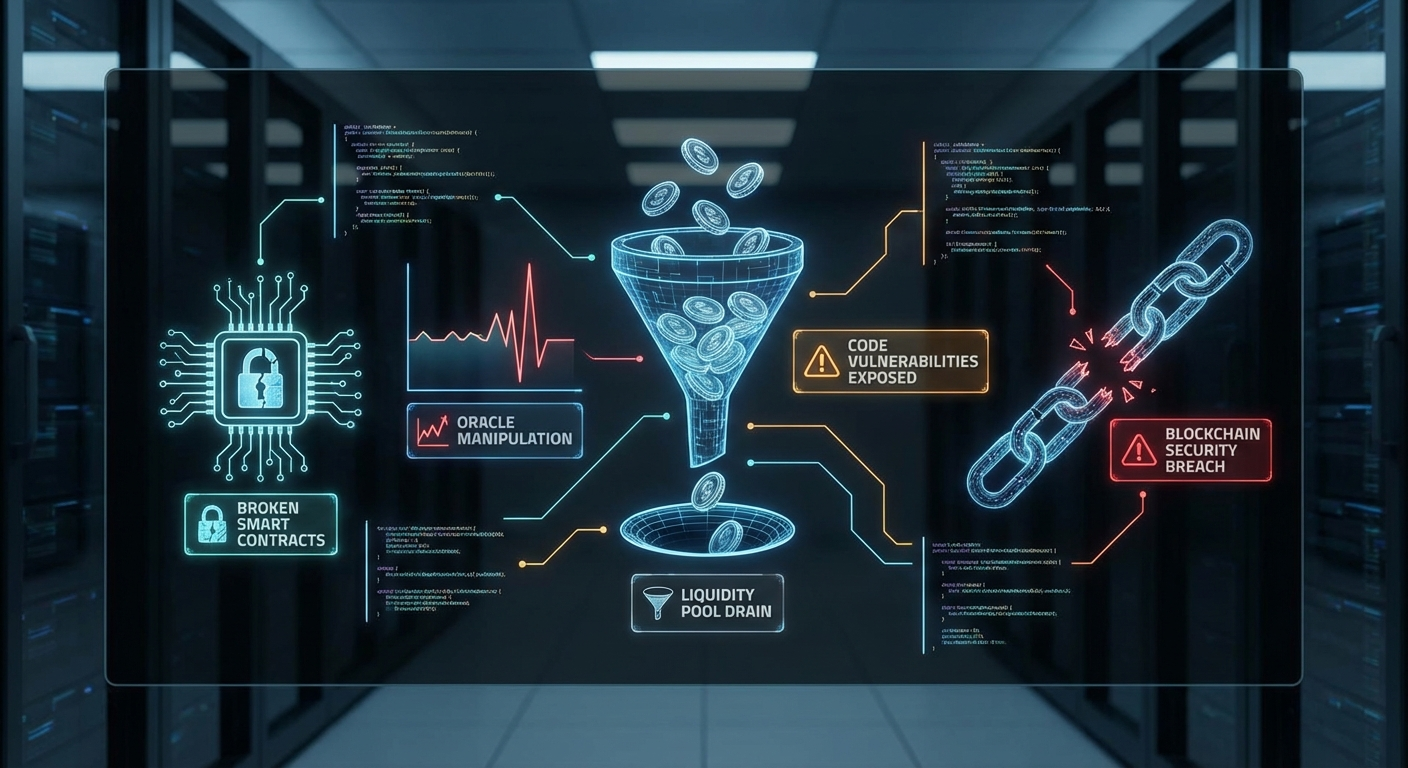
From rounding errors to private key compromises, the 2025 DeFi landscape delivered a masterclass in what can go wrong—and what the industry must do differently.
Executive Summary
2025 will be remembered as one of the most consequential years for DeFi security—and not for the right reasons. Despite significant improvements in smart contract auditing and protocol design, total cryptocurrency theft reached approximately $3.4 billion, with the DeFi sector bearing a substantial portion of these losses. The year kicked off ominously when Moby Trade, an options platform on Arbitrum, lost $2.5 million in January’s first major hack. It ended with security researchers still cataloging the aftermath of breaches that collectively drained billions from protocols, exchanges, and individual wallets.
But this isn’t simply a story of failure. 2025 also demonstrated the growing sophistication of the white hat community, the emergence of protocol-level security improvements, and a fundamental shift in how the industry thinks about attack surfaces. The question facing DeFi participants isn’t whether protocols will be attacked, but whether they’re prepared when it happens.
This comprehensive analysis examines the major exploits of 2025, dissects the technical vulnerabilities that made them possible, and provides actionable guidance for both users and developers navigating this treacherous landscape.
The Numbers: A Sobering Reality Check
Total Losses by the Numbers
According to Chainalysis data released in January 2026, cryptocurrency theft reached $3.4 billion in 2025—a slight increase from 2024’s $3.38 billion. However, the concentration of these losses tells a more complex story:
- Three incidents accounted for 69% of all losses from services- The Bybit exchange hack alone ($1.4 billion) represented 44% of annual losses- 158,000 individual wallet compromises affected 80,000 unique victims- Q1 2025 set an all-time record with $1.64 billion in losses
The Quarterly Pattern
The year followed a distinctive rhythm that security researchers found instructive:
| Quarter | Losses | Notable Trend |
|---|---|---|
| Q1 2025 | $1.64B | Worst quarter on record |
| Q2 2025 | $801M | 52% decrease, shift to mid-sized exploits |
| Q3 2025 | $509M | Code-driven losses dropped sharply |
| September | Spike | 16 million-dollar hacks in single month |
This pattern suggests that while industry-wide security improvements helped reduce the steady drumbeat of smaller exploits, the potential for catastrophic failures remained ever-present.
Case Study #1: Moby Trade — Private Keys and the January Wake-Up Call
What Happened
On January 8, 2025, hackers drained $2.5 million from Moby Trade, a decentralized options platform on Arbitrum, marking the first significant DeFi hack of the year. The attack targeted the protocol’s vault contracts, stealing USDC, WETH, and WBTC through what investigators later confirmed was a private key compromise.
The Attack Vector
The attackers gained control of proxy admin keys, which gave them the ability to:
- Upgrade the vault smart contracts2. Insert malicious code granting unauthorized access3. Call the
emergencyWithdrawERC20function to drain assets
The root cause—leaked or stolen private keys—would become a recurring theme throughout 2025.
The Whitehat Rescue
In an unusual twist, MEV researcher Tony Ke from Solayer Labs/Fuzzland identified that the attacker’s own smart contract contained an unprotected upgrade function. Using this vulnerability against the attacker, Ke managed to rescue $1.5 million in USDC, returning it to the protocol and reducing total losses by 60%.
The remaining $1 million (207 WETH and 3.7 WBTC) was lost. According to Ke, his counter-hack was only “30 seconds too late” to save those funds as well.
Lessons Learned
The Moby Trade hack illustrated two critical lessons:
For protocols:
- Private key security remains the Achilles’ heel of DeFi- Emergency withdrawal functions need additional safeguards beyond key access- Even attackers can be attacked if they deploy sloppy code
For users:
- Protocol claims of “audited” status don’t protect against operational security failures- First-mover disadvantage is real—being an early liquidity provider carries outsized risks
Case Study #2: The Cetus Protocol Catastrophe — $223 Million in 15 Minutes
What Happened
On May 22, 2025, Cetus Protocol—the largest DEX on the Sui blockchain—suffered a devastating exploit that drained approximately $223 million in under 15 minutes. The attack exploited a mathematical error in the protocol’s liquidity calculations, specifically a flawed integer overflow check.
The Technical Details
The vulnerability resided in the checked_shlw function, designed to prevent integer overflows during bit shift operations. The critical error:
Intended check: value

| Protocol | Loss | Attack Method |
| --- | --- | --- |
| Bybit | $1.4B | Supply chain attack on signing infrastructure |
| UPCX | $70M | Malicious smart contract update via compromised key |
| Phemex | $73M | Hot wallet compromise across 16 blockchains |
| Nobitex | $90M | Politically-motivated key theft |
| SwissBorg | $41.5M | Supply chain attack via staking partner |
| Seedify | $1.7M | Developer key compromise (DPRK-attributed) |


### Why Keys Keep Getting Compromised

The Bybit attack—the largest in cryptocurrency history—revealed how sophisticated attackers have become at targeting off-chain infrastructure:

1. **Supply chain infiltration**: Attackers compromised Bybit's signing infrastructure, not the smart contracts themselves2. **Social engineering**: Legitimate-appearing requests tricked signers into authorizing malicious transactions3. **Operational complexity**: Multi-chain operations create multiple points of failure

---

## How Did Audit Firms Perform in 2025?

### The Uncomfortable Truth

A 2026 analysis by SoluLab found that **only 20% of hacked protocols had undergone security audits**. This statistic, while initially encouraging for audit advocates, reveals a troubling nuance: the 20% that were audited still got hacked.

### Where Audits Fell Short

**The Cetus case** is instructive. Despite multiple audits from reputable firms, the flawed overflow check in `checked_shlw` went undetected. Contributing factors:

- **Language assumptions**: Auditors may have assumed Move's overflow protection was comprehensive- **Test coverage gaps**: The specific edge case that caused overflow wasn't in test suites- **Audit scope limitations**: Code reviews don't always catch logical errors in mathematical functions

**The Bunni case** demonstrated another limitation: traditional auditing struggles with novel architectures. The precision error in withdrawal calculations represented "precisely the kind of subtle mathematical mistake that becomes catastrophic at scale"—but it required deep understanding of Uniswap v4's hook system to catch.

### What Audits Can and Cannot Do

**Audits CAN:**

- Identify known vulnerability patterns- Verify code matches specifications- Catch common mistakes (reentrancy, access control gaps)- Improve overall code quality through review

**Audits CANNOT:**

- Guarantee security (nothing can)- Protect against private key compromise- Catch every edge case in complex mathematical logic- Prevent supply chain attacks- Account for economic attacks unique to specific market conditions

### The Emerging Solution: Layered Security

Leading protocols in 2025 moved beyond single audits to comprehensive security programs:

1. **Multiple independent audits** (different firms, different perspectives)2. **Formal verification** for critical mathematical functions3. **Bug bounty programs** with meaningful rewards4. **Runtime monitoring** to detect anomalous behavior5. **Incident response plans** with tested procedures6. **Insurance coverage** from on-chain insurance protocols

---

## Is DeFi Getting More or Less Secure? The 2024 vs. 2025 Comparison

### By the Numbers


| Metric | 2024 | 2025 | Trend |
| --- | --- | --- | --- |
| Total Losses | $2.2B | $3.4B | ⬆️ 55% |
| Number of Incidents | 303 | ~200 | ⬇️ 34% |
| Incidents >$50M | 8 | 6 | ⬇️ 25% |
| Smart Contract Exploits | High | Declining | ⬇️ Improving |
| Private Key Compromises | Rising | Dominant | ⬆️ Concerning |


### The Paradox: Fewer Attacks, More Losses

The data reveals a troubling trend: **DeFi is getting better at preventing small attacks while remaining vulnerable to catastrophic ones**. This suggests:

- Basic smart contract security is maturing- Audit coverage is improving for on-chain code- Attackers are shifting to off-chain targets (keys, infrastructure, supply chains)- When big attacks succeed, they're increasingly sophisticated and damaging

### The TVL Context

Despite increased Total Value Locked (TVL) in DeFi throughout 2025, hack losses **per dollar locked** actually decreased compared to 2021-2022. This suggests:

- Security spending is scaling with value at risk- Mature protocols are genuinely more resilient- The "security premium" of established protocols is real

### The Verdict

**DeFi is getting more secure on-chain but more vulnerable off-chain.** The industry has invested heavily in smart contract security, and it shows. However, the human and operational elements—key management, supply chain security, access controls—remain dangerously under-addressed.

---

## Lessons for DeFi Users

### Before You Deposit

1. **Research the team** — Anonymous teams aren't automatically bad, but they limit accountability2. **Check audit reports** — Look for multiple audits from reputable firms (Trail of Bits, OpenZeppelin, Halborn, CertiK, etc.)3. **Review TVL history** — Sudden spikes or drops can indicate manipulation or exodus4. **Understand the token economics** — Are there unlimited minting capabilities? Who controls them?5. **Test with small amounts** — Never deposit your first time with significant capital

### Ongoing Risk Management

- **Never approve unlimited token spending** — Set specific limits- **Regularly review and revoke approvals** — Use tools like Revoke.cash- **Use hardware wallets** for significant holdings- **Spread risk across protocols** — Diversification applies to DeFi too- **Set alerts for contract upgrades** — Many protocols post announcements before changes

### When Things Go Wrong

- **Document everything** — Transaction hashes, timestamps, wallet addresses- **Report to the protocol** — Many have emergency contacts or bug bounty programs- **Check for recovery efforts** — Some hacks result in partial user compensation- **Be wary of "recovery scams"** — Attackers often target victims with fake recovery offers

---

## Lessons for Protocol Developers

### Smart Contract Security

1. **Assume overflow is possible** — Even in "safe" languages, edge cases exist2. **Test mathematical functions exhaustively** — Especially at boundaries and with extreme values3. **Implement rounding consistently** — Document whether operations round up or down, and why4. **Use established libraries** — OpenZeppelin contracts are battle-tested for a reason5. **Consider formal verification** — For critical functions, mathematical proofs beat testing

### Key Management

1. **Use hardware security modules (HSMs)** — Never store keys in software2. **Implement multi-signature requirements** — No single key should control critical functions3. **Geographic distribution** — Keys held in different jurisdictions reduce single points of failure4. **Regular key rotation** — Limit the window of opportunity for compromised keys5. **Access logging** — Know who accessed what, when

### Operational Security

1. **Vet dependencies thoroughly** — Supply chain attacks are rising2. **Implement upgrade timelocks** — Give users time to exit before changes take effect3. **Monitor on-chain activity** — Anomaly detection can catch exploits in progress4. **Prepare incident response plans** — Know who does what before you need it5. **Consider circuit breakers** — Automatic pauses when metrics exceed thresholds

---

## The Checklist: What to Look for Before Using a New Protocol

Before depositing funds into any DeFi protocol, verify:

### Security Fundamentals

- [ ] **Multiple security audits** from reputable firms (not just one)- [ ] **Bug bounty program** with meaningful rewards (>$100K for critical)- [ ] **Security contact** clearly published- [ ] **No critical findings** unaddressed in audit reports- [ ] **Timelock on upgrades** (minimum 24-48 hours)

### Transparency & Governance

- [ ] **Team identity** (or reputation if pseudonymous)- [ ] **Open source code** with verified contracts- [ ] **Clear documentation** of how the protocol works- [ ] **Decentralized governance** or roadmap toward it- [ ] **Treasury visibility** — know where funds go

### Technical Design

- [ ] **Battle-tested dependencies** (forked from established protocols = better)- [ ] **Reasonable upgrade mechanisms** (not arbitrary admin control)- [ ] **Oracle diversity** (multiple sources, TWAP pricing)- [ ] **Withdrawal functionality** always accessible- [ ] **Emergency pause functionality** with clear triggers

### Track Record

- [ ] **Time in production** (>6 months preferred)- [ ] **TVL history** without unexplained fluctuations- [ ] **No prior exploits** (or transparent handling if there were)- [ ] **Active development** — recent commits, responsive team- [ ] **Community engagement** — active Discord/forum with real users

### Red Flags to Watch

- ❌ Anonymous team with new protocol and high APY- ❌ Single audit from unknown firm- ❌ Unlimited admin permissions- ❌ Missing or minimal documentation- ❌ Pressure to deposit quickly ("limited time!")- ❌ Token economics that require constant new deposits- ❌ Angry or dismissive responses to security questions

---

## Conclusion: The Road Ahead

2025 proved that DeFi security is neither a solved problem nor an impossible one. The industry demonstrated genuine progress in smart contract security—code-driven losses declined quarter over quarter, and fewer individual exploits succeeded. However, the catastrophic breaches that did occur revealed how attackers adapt, shifting from on-chain vulnerabilities to off-chain weaknesses in key management, supply chains, and operational security.

The $3.4 billion in total losses serves as both a warning and a mandate. For DeFi to achieve its promise of permissionless, trustless finance, it must earn the trust it asks users to suspend. That means:

- **For protocols**: Investing in comprehensive security programs that go far beyond single audits- **For users**: Approaching DeFi with the due diligence the stakes deserve- **For the industry**: Sharing lessons from failures as openly as we celebrate successes

The exploits of 2025 were costly. Making them worthwhile requires learning from them. The protocols that thrive in 2026 and beyond will be those that treat security not as a checkbox, but as a continuous practice—one that evolves as fast as the attackers it defends against.

---

*This analysis was prepared for educational purposes. Nothing in this article constitutes financial advice. Always conduct your own research before interacting with any DeFi protocol.*