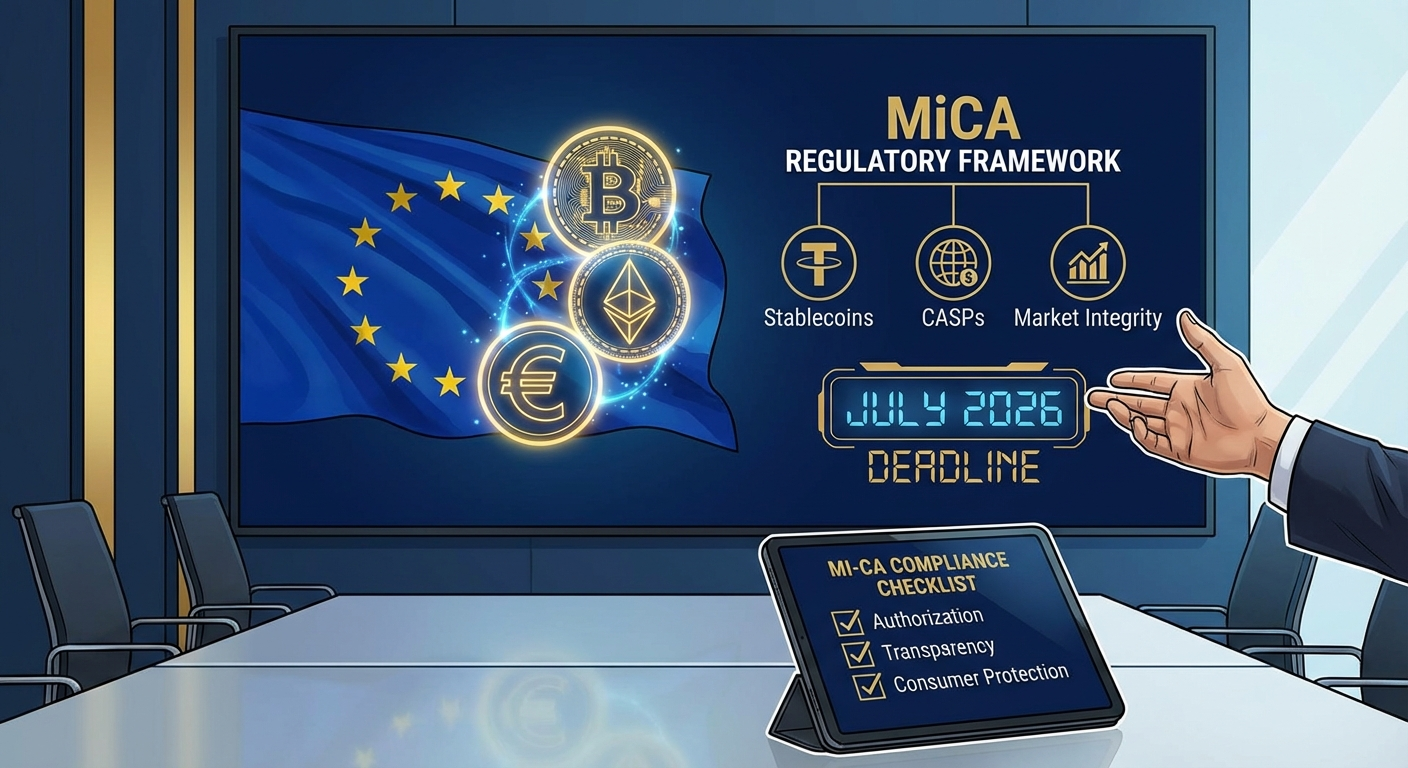
A practical compliance guide for navigating Europe’s landmark crypto regulation
Executive Summary
On July 1, 2026, the European Union’s Markets in Crypto-Assets Regulation (MiCA) enters full enforcement. For the crypto industry, this deadline represents the most significant regulatory milestone since the asset class’s inception. Every Crypto Asset Service Provider (CASP) operating in the EU must be fully authorized or face immediate shutdown. Stablecoin issuers face even stricter requirements, with some needing dual licensing by March 2026.
This isn’t optional. This isn’t negotiable. And for the estimated 1,200+ crypto businesses currently operating across the 27 EU member states—plus hundreds of US-based exchanges serving European customers—the clock is now counting down to a hard regulatory wall.
This guide breaks down exactly what MiCA requires, who it affects, what the major players are doing, and the specific steps businesses must take to survive the transition.
What Is MiCA? Understanding Europe’s Crypto Framework
The Markets in Crypto-Assets Regulation (Regulation EU 2023/1114) is the world’s first comprehensive regulatory framework for cryptocurrencies. Adopted in May 2023 and entered into force in June 2023, MiCA represents the EU’s answer to years of regulatory ambiguity, fragmented national approaches, and high-profile crypto failures like FTX.
The Core Philosophy
MiCA operates on a simple principle embedded in EU financial regulation: same activities, same risks, same rules. If a crypto business performs functions similar to traditional financial services—holding customer assets, facilitating trading, processing payments—it should face comparable regulatory requirements.
The regulation explicitly excludes:
- Financial instruments already covered under MiFID II- Non-fungible tokens (NFTs) that are genuinely unique- Central bank digital currencies (CBDCs)- Decentralized protocols with no identifiable service provider
Everything else—Bitcoin, Ethereum, stablecoins, utility tokens, and the businesses that deal in them—falls under MiCA’s umbrella.
The Phased Implementation Timeline
MiCA’s implementation follows a carefully structured rollout:
| Phase | Date | What Applies |
|---|---|---|
| Entry into Force | June 29, 2023 | Regulation published, preparation begins |
| Stablecoin Provisions | June 30, 2024 | Title III (ARTs) and Title IV (EMTs) apply |
| Full Application | December 30, 2024 | All remaining provisions take effect |
| Grandfathering Ends | July 1, 2026 | All CASPs must be authorized or cease operations |
The grandfathering period—allowing pre-existing operators to continue serving customers while seeking authorization—ends definitively on July 1, 2026, though individual member states may set earlier deadlines.
Crypto Asset Service Providers: The Authorization Imperative
Who Qualifies as a CASP?
Under MiCA Article 3(15), a Crypto Asset Service Provider is any legal person whose occupation or business involves providing one or more crypto-asset services to clients on a professional basis. This encompasses:
Ten Regulated Activities:
- Custody and administration of crypto-assets on behalf of clients2. Operation of a trading platform for crypto-assets3. Exchange of crypto-assets for funds (fiat currency)4. Exchange of crypto-assets for other crypto-assets5. Execution of orders for crypto-assets on behalf of clients6. Placing of crypto-assets (underwriting/distribution)7. Reception and transmission of orders for crypto-assets8. Providing advice on crypto-assets9. Providing portfolio management of crypto-assets10. Providing transfer services for crypto-assets on behalf of clients
If your business performs any of these activities for EU customers—regardless of where you’re headquartered—you need MiCA authorization.
Authorization Requirements
To obtain CASP authorization, businesses must demonstrate:
1. Legal Entity Establishment
- Registered office and head office in an EU member state- For non-EU companies: establishment of an EU-incorporated subsidiary
2. Governance and Fitness
- Management body members must be of “good repute” and possess appropriate knowledge- Clear organizational structure with defined responsibilities- Internal control mechanisms and risk management procedures
3. Capital Requirements
- Class 1 CASPs (custody, exchange, trading platform operation): Minimum €150,000 permanent capital- Class 2 CASPs (order execution, placing, advice): Minimum €50,000 permanent capital- Class 3 CASPs (order reception/transmission only): Minimum €25,000 permanent capital
4. Operational Resilience
- ICT systems meeting EBA technical standards- Business continuity and disaster recovery plans- Cybersecurity frameworks aligned with DORA (Digital Operational Resilience Act)
5. Client Asset Segregation
- Complete separation of client assets from proprietary holdings- Custodial arrangements preventing use of client assets for own account- Clear procedures for asset recovery in case of insolvency
6. Complaint Handling and Disclosure
- Published complaint handling procedures- Clear fee disclosure to clients- Marketing communications that are fair, clear, and not misleading
The Passporting Advantage
Once authorized in one EU member state, CASPs can “passport” their license to provide services across all 27 member states—plus the European Economic Area countries (Norway, Iceland, Liechtenstein). This single market access represents MiCA’s primary value proposition for compliant businesses.
The flip side: without authorization, a business loses access to 450 million potential customers.
Stablecoin Spotlight: The Strictest Rules in Crypto
MiCA reserves its most stringent requirements for stablecoins, which the regulation subdivides into two categories:
E-Money Tokens (EMTs)
E-Money Tokens reference a single official currency (like USD or EUR) and are intended primarily as a means of payment. USDT, USDC, and EURC fall into this category.
EMT Issuance Requirements:
- Issuer must be authorized as an electronic money institution or credit institution- Full reserve backing: 100% of tokens must be backed by segregated reserves- Reserves invested only in highly liquid, low-risk assets- Redemption rights: Any holder can redeem tokens at par value at any time- Daily attestations of reserve composition- Quarterly independent audits
The March 2026 Dual Licensing Challenge:
Starting in early 2026, EMT issuers providing certain payment services may need authorization under both MiCA and the revised Payment Services Directive (PSD2/PSD3). This dual licensing requirement could effectively double compliance costs for affected issuers—a burden that may force smaller stablecoin projects out of the EU market entirely.
Asset-Referenced Tokens (ARTs)
ARTs reference multiple assets—a basket of currencies, commodities, or crypto-assets. They’re designed for value stabilization but not necessarily payment.
ART Requirements Include:
- White paper approval by home member state competent authority- Minimum €350,000 own funds, or 2% of average reserve assets (whichever is higher)- Strict reserve asset composition rules- Conflict of interest management- Governance requirements for token holders
The “Significant” Designation
Both EMTs and ARTs can be designated as “significant” by ESMA and EBA if they exceed thresholds including:
- Customer base over 10 million- Market capitalization over €5 billion- Daily transaction volume over €500 million
Significant tokens face heightened requirements including higher capital buffers, liquidity management plans, and direct EBA supervision rather than national regulator oversight.
Impact on Major Players: Tether, Circle, and Binance
The MiCA deadline is forcing strategic decisions at the highest levels of the crypto industry.
Tether (USDT): The Existential Question
Tether, issuer of USDT—the world’s largest stablecoin with over $140 billion in circulation—faces the most uncertain path under MiCA.
The Core Problem:
USDT would qualify as an E-Money Token under MiCA, requiring Tether to:
- Obtain EMI authorization in an EU member state- Maintain fully segregated, audited reserves accessible to European regulators- Provide guaranteed at-par redemption to all EU holders- Submit to ongoing EU regulatory supervision
Tether’s historically opaque reserve disclosures and incorporation in the British Virgin Islands create significant hurdles. The company has not, as of early 2026, obtained EMI authorization in any EU jurisdiction.
Potential Scenarios:
- Full compliance: Tether establishes an EU subsidiary, obtains EMI license, restructures reserves for transparency2. EU exit: Tether withdraws USDT from European markets, forcing EU users to alternative stablecoins3. Hybrid approach: Tether launches a MiCA-compliant euro stablecoin while deprecating USDT for EU users
Major EU exchanges have already begun delisting USDT in preparation for the July 2026 deadline. If Tether doesn’t achieve compliance, European traders will need to transition to alternatives—creating massive market disruption.
Circle (USDC/EURC): The First-Mover Advantage
Circle has positioned itself as the MiCA-compliant stablecoin issuer of choice.
Circle’s EU Strategy:
- Circle has obtained EMI authorization through European regulators- USDC and EURC already marketed as MiCA-compliant stablecoins- Reserve attestations published with Big Four accounting firm verification- Partnership expansion with European banks and payment providers
Circle’s early compliance investment appears to be paying strategic dividends. As competing stablecoins face delisting or uncertainty, Circle is actively marketing to EU institutions seeking regulatory clarity.
The Competitive Opportunity:
If Tether fails to achieve MiCA compliance, Circle stands to capture significant market share among European users—potentially billions in transaction volume migrating from USDT to USDC.
Binance: The Regulatory Rehabilitation
Binance, the world’s largest crypto exchange by trading volume, has pursued an aggressive EU compliance strategy following years of regulatory battles.
Binance’s MiCA Approach:
- Obtained MiCA authorization through multiple EU jurisdictions- Restructured European operations under EU-incorporated entities- Appointed dedicated EU compliance leadership- Implemented enhanced KYC/AML procedures exceeding baseline requirements
Binance’s European approval represents a significant reversal from 2021-2023, when multiple EU regulators issued warnings about the exchange’s lack of authorization. The company’s willingness to accept stringent conditions—including enhanced supervisory access—demonstrates the strategic value of EU market access.
What US Exchanges Need to Know
American crypto exchanges serving European customers face a clear choice under MiCA: establish a compliant EU presence or withdraw from the market.
The Extraterritorial Reality
MiCA applies to any business providing crypto services to EU residents, regardless of where that business is located. A US exchange with European customers is performing regulated activities under EU law—even if operating entirely from servers in Delaware.
Common Strategies
Option 1: EU Subsidiary Establish a MiCA-authorized subsidiary in an EU member state. This provides passporting rights across all 27 countries but requires:
- Physical presence (office, staff)- Local directorship with EU residency- Separate capital allocation- Full regulatory compliance infrastructure
Coinbase, Kraken, and Gemini have all pursued variants of this approach.
Option 2: Strategic Partnership Partner with an existing EU-authorized entity to white-label services or handle EU customer relationships. Lower capital requirements but reduced control and margin compression.
Option 3: Market Exit Cease serving EU customers entirely. Some smaller US exchanges, concluding that compliance costs exceed EU revenue potential, have already geoblock European IP addresses.
Key Considerations for US Operators
- Timeline Pressure: Authorization applications take 6-12 months. Starting in early 2026 means risking missing the July deadline.2. Regulatory Forum Shopping: Different EU member states offer varying authorization speeds and regulatory cultures. Ireland, France, Germany, and the Netherlands have emerged as popular choices.3. Substance Requirements: “Letterbox” entities without genuine operational presence will face scrutiny. Regulators expect management, compliance, and operational functions in-jurisdiction.4. Ongoing Obligations: Authorization is not a one-time event. MiCA requires continuous compliance reporting, incident notification, and supervisory cooperation.
The Countdown Timeline: What Must Happen Before July 2026
Now – March 2026 (Critical Preparation Phase)
Immediate Actions:
- Complete legal entity analysis: Does your business structure meet MiCA requirements?- [ ] Identify optimal authorization jurisdiction- [ ] Engage local legal counsel and compliance consultants- [ ] Begin application document preparation
Strategic Decisions:
- Determine which crypto-asset services to seek authorization for- [ ] Assess capital adequacy against MiCA requirements- [ ] Evaluate technology and operational readiness
March – May 2026 (Application Submission Window)
If Not Already Submitted:
- Complete and file authorization application with chosen National Competent Authority- [ ] Prepare for regulatory Q&A and supplementary documentation requests- [ ] Implement required governance structures- [ ] Establish compliant custodial arrangements
For EMT Issuers:
- Assess dual licensing requirements under MiCA + PSD2- [ ] Prepare reserve segregation documentation- [ ] Arrange independent audit coverage
May – June 2026 (Final Preparations)
Operational Readiness:
- Complete ICT system updates for regulatory reporting- [ ] Train staff on MiCA compliance procedures- [ ] Update client disclosures and marketing materials- [ ] Test incident reporting and notification systems
Contingency Planning:
- Prepare communications for authorization delays- [ ] Establish service continuity arrangements with partner institutions- [ ] Document customer asset protection procedures
July 1, 2026 (Enforcement Deadline)
If Authorized:
- Confirm passporting notifications for all target member states- [ ] Publish MiCA-compliant white papers for listed tokens- [ ] Activate full compliance monitoring systems
If Not Authorized:
- Cease regulated activities immediately- [ ] Initiate customer asset return procedures- [ ] Comply with orderly wind-down requirements
ESMA’s Level 2 and Level 3 Measures: The Technical Details
Beyond the primary regulation, MiCA mandates extensive implementing and delegated acts—known as Level 2 and Level 3 measures—that specify technical requirements.
Key Technical Standards Already Published
For CASPs:
- Order book record-keeping formats and data standards- Complaint handling procedure requirements- Information to be provided to clients- Policies for identifying, preventing, and managing conflicts of interest
For Token Issuers:
- White paper content and formatting requirements- Sustainability disclosure standards (environmental impact of consensus mechanisms)- Marketing communication requirements
For Competent Authorities:
- Authorization application templates- Supervisory cooperation arrangements- Notification procedures for cross-border activity
ESMA published a comprehensive overview of all Level 2 and Level 3 measures in November 2025, with most implementing regulations now in force. Businesses should review these technical standards carefully, as they contain specific requirements not apparent from the primary regulation text.
Supervisory Convergence: The Grandfathering Reality
ESMA has worked intensively with National Competent Authorities to ensure consistent authorization approaches across member states. Key documents include:
The Grandfathering Period List
Not all EU member states adopted the same grandfathering periods. Some permitted full transitional periods until July 2026; others imposed earlier deadlines. ESMA maintains an official list of grandfathering periods by member state—businesses must verify their specific timeline based on where they currently hold national authorization or registration.
Countries with Shortened Grandfathering: Some member states have already required conversion from national registrations to full MiCA authorization ahead of the July 2026 deadline. Operators in these jurisdictions face earlier compliance requirements.
What Happens to Non-Compliant Operators?
After July 1, 2026, operating without MiCA authorization constitutes a regulatory violation subject to:
- Administrative fines up to €5 million or 3% of annual turnover for individuals- Administrative fines up to €15 million or 12.5% of annual turnover for legal entities- Publication of enforcement decisions (“name and shame”)- Potential criminal referral under national law
ESMA has explicitly warned that enforcement will be robust from day one—there is no informal grace period beyond July 1, 2026.
Strategic Implications: Winners and Losers
Likely Winners
Large, Well-Capitalized Exchanges: Compliance costs favor scale. Binance, Coinbase, and Kraken can absorb €150,000 minimum capital requirements and multi-million euro compliance programs. Smaller competitors cannot.
MiCA-Compliant Stablecoins: Circle’s USDC and EURC stand to benefit enormously if competing stablecoins fail to achieve compliance. First-mover advantage in regulatory acceptance creates lasting market position.
Compliance Service Providers: Law firms, RegTech companies, and consulting practices specializing in MiCA implementation are experiencing unprecedented demand.
EU-Domiciled Projects: Tokens and protocols with genuine EU development teams may find marketing advantages in their “MiCA-native” status.
Likely Losers
Small and Medium Exchanges: The compliance burden falls disproportionately on smaller operators. Many will exit the EU market or merge with larger competitors.
Anonymous/Privacy-Focused Projects: MiCA’s KYC requirements and restrictions on privacy coins make the EU an inhospitable market for privacy-focused cryptocurrency projects.
Decentralization Theater: Projects claiming “decentralization” while maintaining identifiable development teams and treasuries may face forced compliance or EU exclusion.
The Bigger Picture: MiCA as Global Template
Europe’s comprehensive approach is influencing regulatory discussions worldwide. Jurisdictions including the UK (with its own crypto framework), Singapore, Hong Kong, and even US regulators are watching MiCA’s implementation closely.
For global crypto businesses, achieving MiCA compliance may become a de facto prerequisite for serious institutional adoption—a stamp of regulatory credibility that opens doors beyond Europe.
The July 2026 deadline is not just about EU market access. It’s about positioning for a future where comprehensive crypto regulation becomes the global norm rather than the exception.
Compliance Checklist for Crypto Businesses
Immediate (Complete Now)
- Classify your activities: Determine which MiCA services apply to your business- [ ] Assess current authorization: Document existing national registrations/licenses- [ ] Identify gaps: Compare current compliance status against MiCA requirements- [ ] Engage advisors: Retain EU legal counsel and compliance consultants- [ ] Select jurisdiction: Choose target member state for authorization application
Near-Term (By End of Q1 2026)
- Prepare application: Compile authorization documentation- [ ] Establish governance: Appoint compliant management board- [ ] Capitalization: Ensure minimum capital requirements are met- [ ] Custodial arrangements: Implement client asset segregation- [ ] Technology audit: Assess ICT systems against DORA requirements
Pre-Deadline (Q2 2026)
- Submit application: File with National Competent Authority- [ ] Staff training: Complete MiCA compliance training programs- [ ] Update disclosures: Revise client-facing documentation- [ ] Test reporting: Validate regulatory reporting systems- [ ] Contingency planning: Document scenarios for authorization delays
For Stablecoin Issuers (Additional Items)
- EMI/Credit institution licensing: Complete electronic money authorization- [ ] Reserve structuring: Implement compliant reserve asset composition- [ ] Audit arrangements: Engage independent auditors for reserve attestations- [ ] Redemption procedures: Establish at-par redemption infrastructure- [ ] Dual licensing assessment: Evaluate PSD2 requirements for payment services
Conclusion: The End of Crypto’s Regulatory Arbitrage Era
MiCA represents a fundamental shift in how cryptocurrency businesses operate in one of the world’s largest markets. The regulation’s comprehensive scope, substantial penalties, and hard deadline leave no room for ambiguity.
For businesses serious about serving European customers, compliance is not optional—it’s existential. The July 1, 2026 deadline will separate sustainable crypto enterprises from those relying on regulatory gaps that no longer exist.
The countdown is on. The requirements are clear. The only question remaining is whether your business will be ready.
This article is for informational purposes only and does not constitute legal advice. Businesses should consult qualified legal and compliance professionals for guidance specific to their circumstances.