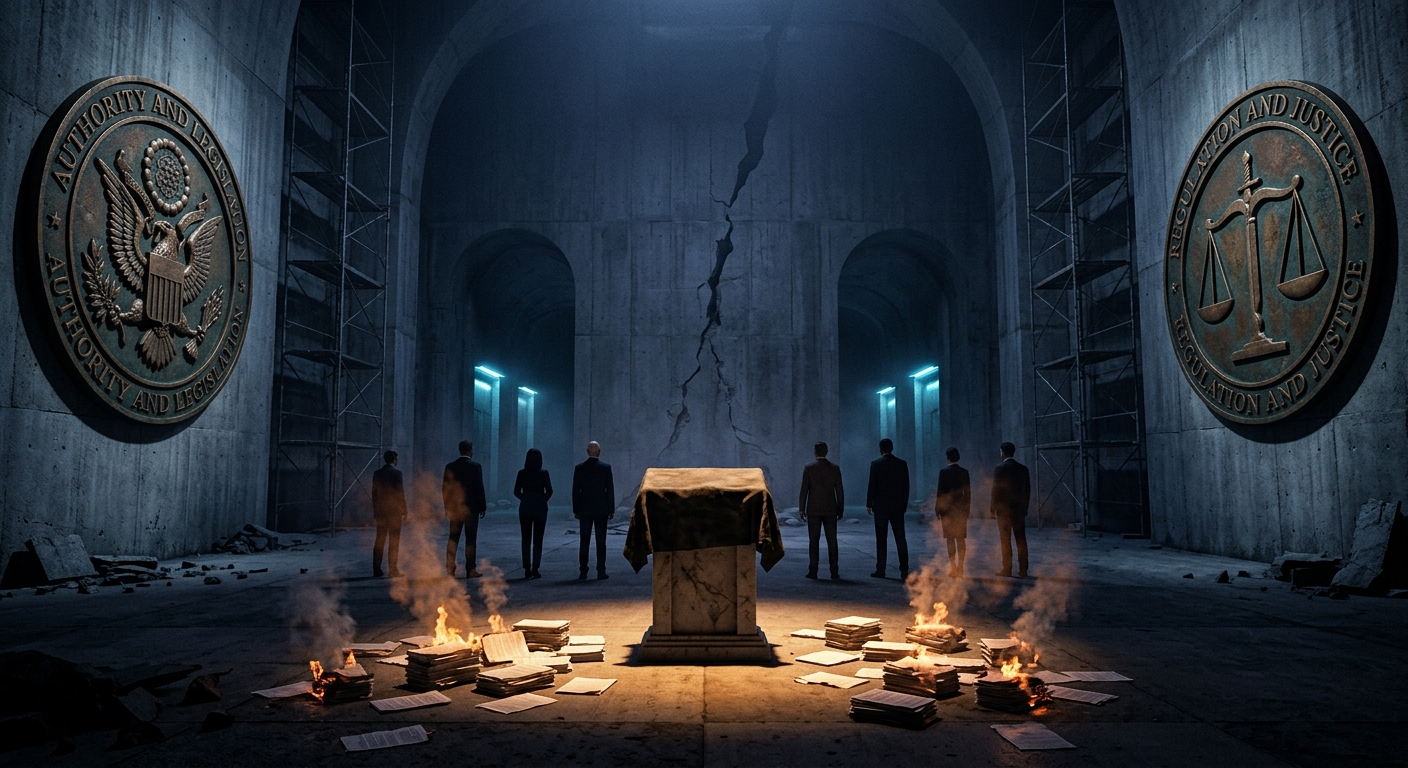
The Strategic Bitcoin Reserve was created by executive order on 6 March 2025 and was, at the time, the most significant sovereign endorsement cryptocurrency had received. A G7 treasury declaring bitcoin a permanent national asset is not a small thing, and it was not read as one.
Eighteen months on it is worth doing what nobody does with policy announcements: checking what was actually built.
The short version — it has never purchased a bitcoin, its own officials have given holdings figures differing by 130,000 BTC, the founding audit found private keys in desk drawers, one custodian was exploited for over $60 million, and the whole structure sits on an executive order with no statute underneath it.
Yesterday we wrote that US crypto policy is being run through instruments with no floor under them. The reserve is the clearest example.
Nobody Agrees How Much It Holds
Two official-adjacent figures are in circulation:
| Figure | Source | Date |
|---|---|---|
| 328,372 BTC (~$25.4B) | White House digital asset advisor Patrick Witt, Consensus Miami | 6 May 2026 |
| ~198,000 BTC | Reserve holdings as commonly reported | Mid-2026 |
The gap is roughly 130,000 BTC — at current prices, over $8 billion.
The explanation is definitional rather than scandalous: the larger number counts everything the government has custody of, including seized assets still subject to proceedings that may be returned to victims. The smaller counts assets actually forfeited and therefore genuinely the government’s.
That the distinction was not resolved before the announcement is the point. The reserve’s core promise is that it is permanent and never sold. A material share of the headline balance is money the government may be legally obliged to hand back.
The composition also deserves stating plainly. The holdings come almost entirely from law enforcement seizures — Silk Road from 2013 onward, and the 94,636 BTC recovered from the 2016 Bitfinex hack in 2022. The United States did not accumulate a bitcoin position. It prosecuted crimes and kept the proceeds, then reclassified the pile as strategy.
The Custody Findings
The executive order required an audit, completed by the 5 April 2025 deadline, with a public report on 30 July 2025.
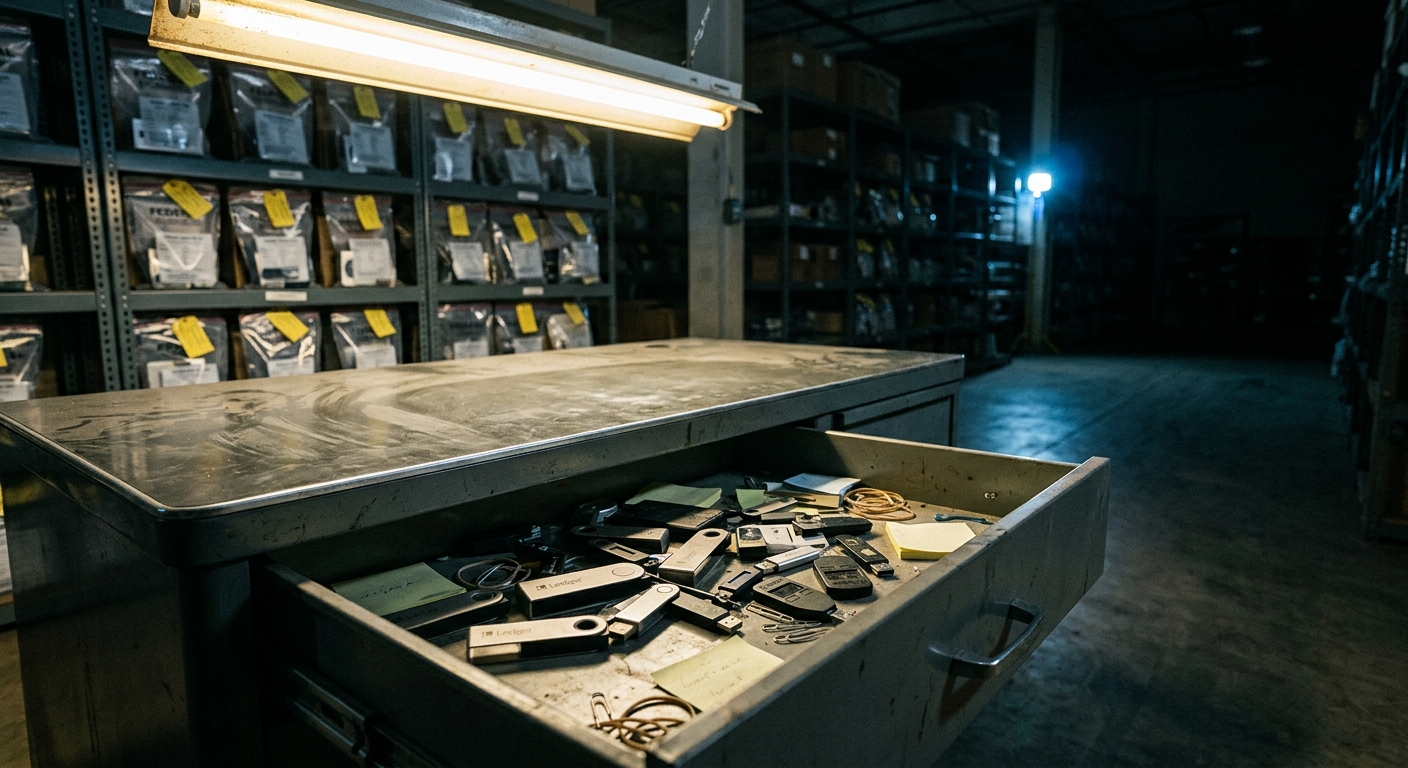
The finding, in the words of White House advisor Patrick Witt: cold wallets stored in desk drawers across federal agencies.
There was no unified custody standard, no consolidated inventory, and no consistent key-management practice — because until the order existed, nothing required one. Individual agencies had been holding seized crypto as evidence, using whatever their case teams devised.
Then, in late 2025, US Marshals Service holdings were hit by an exploit costing more than $60 million.
Set that against the standard the government applies to everyone else. Registered custodians face SEC custody rules, qualified-custodian requirements, segregation obligations, and audit regimes. The exchanges we cover are expected to run HSM-backed key ceremonies, multi-party computation, and geographically distributed multisig — we have written about threshold signatures as the baseline for institutional key security.
The federal government held $25 billion in bearer assets to a materially lower standard than it requires of a mid-sized exchange, and lost eight figures proving it.
It Cannot Buy Anything
The most persistent misconception is that the reserve accumulates bitcoin.
The executive order permits studying budget-neutral acquisition mechanisms. It does not authorise purchases. Treasury Secretary Scott Bessent put it directly in August 2025: “We’re not going to be buying that but are going to use confiscated assets.”
There is no active acquisition programme, and there has never been one. The reserve grows when a prosecution succeeds. That is its entire accumulation mechanism.
This makes the “Bitcoin superpower” framing hard to sustain. A strategic reserve of oil or grain implies procurement. This is an asset-retention policy applied to forfeiture proceeds — defensible, arguably sensible, and a fundamentally different thing from what was announced.
The Legislative Fight
Two bills would put a statute underneath it, and they differ on the question that matters.
ARMA — American Reserve Modernization Act. Introduced May 2026 by Reps. Nick Begich (R-AK) and Jared Golden (D-ME). Codifies the framework, imposes a 20-year lockup, sets custody standards and operational safeguards. Notably, it drops the 1 million BTC target and merely directs Treasury to study acquisition feasibility.
The BITCOIN Act (S.954). Senator Cynthia Lummis. Mandates acquisition of 1 million BTC over five years, funded through gold certificate revaluation and Federal Reserve net earnings, with the same 20-year hold.
Neither has passed.
ARMA is the more revealing bill. It is the bipartisan option — a Republican and a Democrat, custody standards, a lockup — and it gets there by removing the purchase mandate entirely. That is the deal available: Congress may be willing to make the reserve permanent, but not to make it a buyer.
Given the CLARITY Act’s collapse and a Senate calendar with two to three working weeks after 14 September, neither bill is moving in 2026.
What Is Actually Good Here
Three things are genuine improvements, and it would be unfair to skip them:
The custody problem is now visible. Desk-drawer key storage existed for years before the order. The audit did not create the failure — it found it. Consolidation under Treasury with defined standards is a real upgrade over dispersed agency evidence lockers.
Not selling is defensible policy. Germany’s 2024 sale of nearly 50,000 BTC into a rising market cost its taxpayers billions in foregone value. A default-hold policy for forfeited assets avoids that, whatever one thinks of bitcoin.
The signal was real even if the substance was thin. Sovereign legitimation shifted institutional risk assessments in ways that survive the drawdown.
The Structural Problem
Everything above rests on an executive order.
A future president can revoke it. The bitcoin can be ordered sold. There is no statutory lockup, no independent custodian mandate, and no congressional appropriation to unwind — just a directive that exists at one office’s discretion.
That is the same fragility running through the whole US crypto stack right now: market structure by agency rulemaking, the reserve by executive order, and enforcement by prosecutorial discretion. The only crypto policy with a statute under it is stablecoins, via the GENIUS Act.
At $63,500 a coin, the reserve is not underwater in any meaningful sense — its cost basis is a prosecution budget, not a purchase price. But it is worth roughly half what it was on paper at the October 2025 peak, and it is precisely at valuations like this that “budget-neutral acquisition” would matter and the political will to legislate it is thinnest.
Eighteen months in, the United States has a bitcoin reserve in the sense that it has bitcoin and has promised not to sell it. Everything else — the acquisition strategy, the statutory permanence, the custody standard, even the balance — is still under construction, or was never really there.
Sources: crypto.news — Inside the Strategic Bitcoin Reserve · The Block — What is the US Strategic Bitcoin Reserve · Outlook — March 2026 custody framework · Wikipedia — U.S. Strategic Bitcoin Reserve