TL;DR: Apple patched a critical zero-click vulnerability (CVE-2025-43300) that allowed sophisticated attackers to compromise devices through malicious images sent via iMessage, putting cryptocurrency wallets at risk of irreversible theft. The flaw, already exploited in targeted attacks, highlights the growing threat to digital asset holders as 2025 crypto losses surpass $2.4 billion.
The Vulnerability That Doesn’t Need Your Click
In August 2025, Apple issued an urgent security advisory that sent shockwaves through the cryptocurrency community. The tech giant revealed it had patched a zero-click vulnerability—one that could compromise iPhones, iPads, and Macs without any user interaction whatsoever.
Tracked as CVE-2025-43300 with a CVSS score of 8.8, this flaw lurked within Apple’s ImageIO framework, the core component responsible for processing image files across all Apple devices. The vulnerability’s exploitation mechanism is particularly insidious: a single malicious image sent through iMessage could automatically trigger memory corruption, granting attackers unauthorized access to the device’s most sensitive areas.
“This is a zero-click vulnerability that does not require user interaction,” explained Juliano Rizzo, CEO of cybersecurity firm Coinspect. “An attachment delivered via iMessage can be processed automatically and lead to device compromise.”
Why Crypto Holders Are Prime Targets
The implications for cryptocurrency users are especially alarming. Unlike traditional financial systems where transactions can often be reversed, cryptocurrency transfers are irreversible by design. This immutable nature makes digital asset holders particularly attractive targets for sophisticated cybercriminals.
Once attackers gain access to a compromised device, they can potentially:
- Access stored wallet private keys and seed phrases- Monitor wallet transactions and balances- Compromise exchange account credentials- Execute unauthorized transfers that cannot be reversed
The vulnerability’s zero-click nature means even security-conscious users who exercise extreme caution online could still fall victim to attacks. No suspicious links need to be clicked, no malicious files need to be downloaded—simply receiving an image through iMessage could be enough to compromise the entire device.
The 2025 Crypto Security Crisis
This Apple vulnerability emerges against a backdrop of unprecedented cryptocurrency security breaches in 2025. According to multiple security firms, the first half of 2025 alone has witnessed over $2.4 billion stolen from crypto platforms and individual users—already surpassing the entire year’s losses from 2024.
Key statistics from 2025’s first six months include:
- 334 successful attacks resulting in $2.47 billion in losses (CertiK)- Wallet compromises accounting for $1.7 billion from just 34 attacks- Phishing attacks leading 132 incidents with $410 million stolen- Ethereum remaining the most targeted blockchain with 70 major incidents
The two largest incidents—the $1.5 billion Bybit exchange hack and the $225 million Cetus Protocol exploit—demonstrate how single vulnerabilities can result in catastrophic losses. Without these outlier events, total losses would still reach approximately $690 million, indicating systemic security challenges across the crypto ecosystem.
Technical Deep Dive: How the Exploit Works
CVE-2025-43300 is classified as an “out-of-bounds write” vulnerability within the ImageIO framework. This technical flaw allows attackers to manipulate memory regions that should be completely inaccessible, essentially giving them the keys to the digital kingdom.
Here’s how a typical attack would unfold:
- Delivery: A malicious image is sent via iMessage or processed through any app using the ImageIO framework2. Automatic Processing: The device automatically processes the image without user interaction3. Memory Corruption: The malicious image triggers an out-of-bounds write, corrupting device memory4. Code Execution: Attackers gain the ability to execute arbitrary code on the compromised device5. Data Extraction: Sensitive information, including crypto wallet data, becomes accessible
The sophistication required for such attacks typically points to state-sponsored groups or highly organized cybercriminal organizations with advanced capabilities.
Apple’s Response and Industry Impact
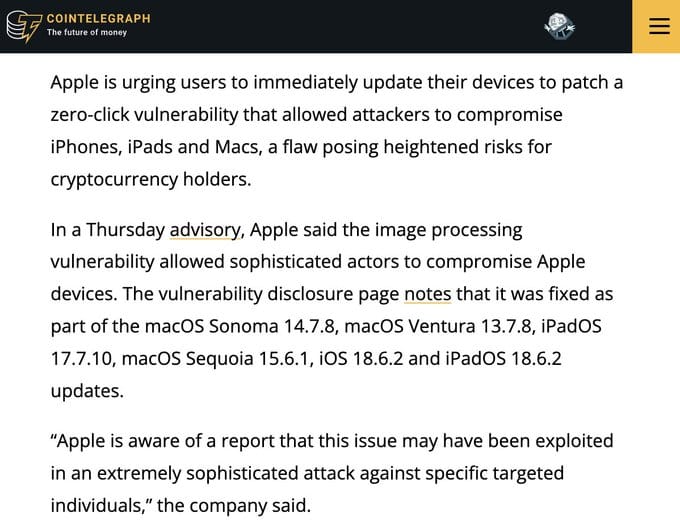
Apple confirmed the vulnerability was discovered internally and acknowledged reports of its exploitation “in an extremely sophisticated attack against specific targeted individuals.” The company released emergency patches across all major platforms:
- iOS 18.6.2 and iPadOS 18.6.2 for newer devices- iPadOS 17.7.10 for older iPad models- macOS Sequoia 15.6.1, Sonoma 14.7.8, and Ventura 13.7.8 for Mac computers
The U.S. Cybersecurity and Infrastructure Security Agency (CISA) took the unusual step of adding the vulnerability to its Known Exploited Vulnerabilities catalog, mandating government agencies to apply patches by September 11, 2025.
This marks the seventh zero-day vulnerability Apple has patched in 2025 that was actively exploited in the wild, suggesting an escalating threat landscape for Apple device users.
The North Korean Connection
Security experts believe the vulnerability may have been exploited by North Korean state-sponsored hacking groups, particularly the notorious Lazarus Group. These actors have dramatically intensified their cryptocurrency theft operations in 2025, with known North Korean-related losses already reaching $1.5 billion—far exceeding their previous annual record of $1.3 billion in 2024.
North Korean groups have demonstrated particular sophistication in targeting cryptocurrency infrastructure, often using advanced social engineering tactics and supply chain compromises to infiltrate crypto-related services.
Immediate Action Required
For cryptocurrency holders, the threat posed by CVE-2025-43300 demands immediate action:
Essential Steps:
- Update Immediately: Don’t wait for automatic updates—manually install iOS 18.6.2, iPadOS 18.6.2, or the latest macOS patches2. Monitor Accounts: Check all cryptocurrency wallets and exchange accounts for unauthorized activity3. Secure Primary Accounts: Enable two-factor authentication on email and cloud storage accounts that could be used for password resets
For High-Value Targets:
Security expert Juliano Rizzo recommends that individuals with significant cryptocurrency holdings who suspect compromise should consider:
- Migrating wallet keys if there’s any evidence of device targeting or unusual activity- Securing primary accounts (email, cloud services) immediately- Creating a clear incident response plan before implementing changes
“The key is to stay calm, document a clear plan, and start by securing primary accounts that attackers could exploit for password resets or further access,” Rizzo advised.
The Broader Implications
The CVE-2025-43300 incident highlights several critical issues in the intersection of device security and cryptocurrency safety:
Detection Challenges
For average users, identifying exploitation of zero-click vulnerabilities is nearly impossible. System logs could theoretically reveal anomalies, but as security experts note, this data is extremely difficult to interpret without specialized knowledge.
Vendor Responsibility
Companies like Apple are often better positioned to detect exploitation patterns and notify victims directly. The rapid disclosure and patching of this vulnerability demonstrates responsible security practices, but also reveals how vulnerable users can be before patches arrive.
Infrastructure Risks
The incident underscores the risks of storing significant cryptocurrency assets on general-purpose devices that may be vulnerable to sophisticated attacks. Hardware wallets and air-gapped storage solutions become increasingly important as attack vectors evolve.
Looking Forward: Lessons for the Crypto Community
As 2025’s cryptocurrency theft statistics continue climbing, the Apple vulnerability serves as a stark reminder that digital asset security extends far beyond wallet software and exchange protections. The devices we use to access our crypto holdings can themselves become attack vectors for sophisticated threat actors.
Key Takeaways:
- Zero-click vulnerabilities represent an evolving threat that bypasses traditional user education approaches- Device security is inseparable from cryptocurrency security in our interconnected ecosystem- Rapid patching remains one of the most effective defenses against known vulnerabilities- Layered security approaches combining hardware wallets, secure devices, and monitoring systems provide the best protection
The cryptocurrency industry’s rapid growth has inevitably attracted increasingly sophisticated threat actors. As the stakes continue to rise—with individual attacks now reaching into the billions of dollars—the need for comprehensive security strategies has never been more critical.
The Bottom Line
CVE-2025-43300 represents more than just another security vulnerability—it’s a wake-up call for the entire cryptocurrency ecosystem. In a world where digital assets can be stolen irreversibly through a single malicious image, the traditional approach of “being careful online” is no longer sufficient.
As crypto adoption continues expanding and individual holdings grow larger, the security of the devices we use to access these assets becomes paramount. Apple’s rapid response to this vulnerability demonstrates the importance of vendor vigilance, but it also highlights how quickly our digital lives can be compromised by threats we never see coming.
For cryptocurrency holders, the message is clear: update your devices immediately, implement layered security practices, and remember that in the world of digital assets, prevention isn’t just better than cure—it’s often the only cure available.
This article is based on security research and industry reports available as of August 2025. Cryptocurrency security is a rapidly evolving field, and users should always consult the latest security guidance from reputable sources.