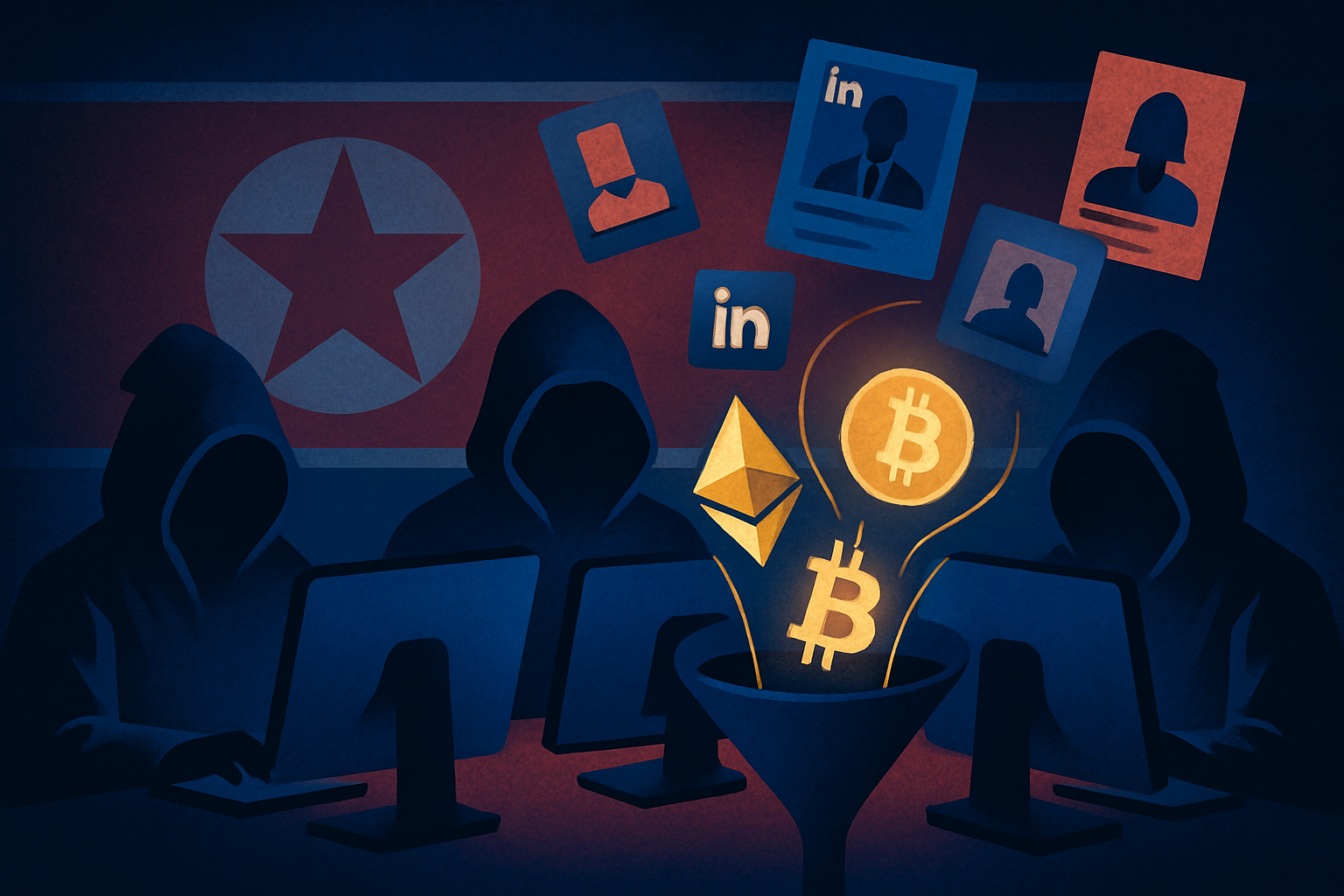
On March 12, 2026, the U.S. Treasury’s Office of Foreign Assets Control (OFAC) designated new sanctions targets tied to North Korea’s growing army of IT workers operating inside cryptocurrency and Web3 companies. The designations represent a significant escalation in the U.S. government’s effort to disrupt a revenue stream that intelligence agencies estimate generates hundreds of millions of dollars annually for the DPRK regime.
But the sanctions themselves are only part of the story. What Chainalysis’s accompanying analysis reveals is far more disturbing: North Korean operatives have evolved from simply applying for remote jobs at crypto firms to orchestrating elaborate fake hiring processes — posing as recruiters for prominent Web3 and AI companies to harvest credentials, source code, and VPN access from their targets.
The Lazarus Group’s $1.5 billion theft from Bybit in February 2025 was a single spectacular heist. The IT worker infiltration program is something far more insidious — a slow, patient, distributed operation that’s generating persistent access to the crypto ecosystem’s most sensitive systems.
The Evolution of the DPRK IT Worker Threat
North Korea’s deployment of IT workers to generate foreign currency isn’t new. The UN Panel of Experts has tracked the program for years, estimating that thousands of DPRK nationals work remotely for companies worldwide, using stolen identities and elaborate cover stories.
What’s changed in 2025-2026 is the scope, sophistication, and crypto-specificity of the operation.
Phase 1: The Job Applicant (2020-2023)
In the early iterations, DPRK IT workers simply applied for remote development jobs at crypto firms. They used stolen or fabricated identities, often with AI-generated profile photos, and relied on the industry’s remote-first culture and lax background checks to get hired.
Once embedded, they would:
- Divert salary payments to regime-controlled accounts
- Exfiltrate source code and proprietary technology
- Map internal systems for future exploitation by Lazarus Group operators
The FBI and CISA issued multiple advisories about this threat, and some companies implemented stronger verification procedures. But the program adapted.
Phase 2: The Recruiter (2024-2025)
According to Chainalysis’s latest analysis, DPRK operatives shifted tactics. Instead of merely applying for roles, they began impersonating recruiters for prominent Web3 and AI firms.
The attack flow:
- Target identification. Identify developers working at crypto companies with access to wallets, smart contracts, or infrastructure credentials.
- Recruiter impersonation. Create convincing LinkedIn profiles and email personas mimicking recruiters from high-profile firms. Use real company names, branding, and job listings.
- Technical screen trap. Invite targets to “technical interviews” that require executing code samples, installing “assessment tools,” or sharing screen during “pair programming sessions.”
- Credential harvesting. The “assessment” deploys malware that captures browser sessions, SSH keys, wallet credentials, and VPN configurations — giving attackers access to the target’s actual employer.
This is a supply-chain attack using social engineering instead of software vulnerabilities. And it’s devastatingly effective because it exploits something the tech industry takes for granted: the interview process itself.
Phase 3: The Hybrid Approach (2026)
Current intelligence suggests DPRK operations now combine both approaches simultaneously:
- Embedded workers inside companies provide persistent access and intelligence
- Recruiter impersonators target employees at companies they haven’t infiltrated yet
- Lazarus Group operators exploit access gained by both channels for large-scale theft
The three programs support each other. An embedded worker can confirm which systems are valuable. A recruiter operation can harvest the credentials needed to access them. Lazarus Group executes the heist.
The Bybit Connection
The February 2025 Bybit hack — the largest cryptocurrency theft in history at $1.5 billion — was a masterclass in this hybrid approach.
As BlockEden’s analysis revealed, the attack began with a compromised laptop belonging to a developer at SafeWallet, the multisig infrastructure provider Bybit used. Within seventeen days, that single compromised endpoint was leveraged to manipulate Bybit’s cold wallet signing process, redirecting 500,000 ETH to attacker-controlled addresses.
The attack exploited the trust chain between a third-party vendor (SafeWallet) and its client (Bybit) — the exact kind of access that embedded IT workers or recruiter-based credential theft would provide.
Despite global tracking efforts and a Bybit-sponsored bounty program, the hackers laundered at least $300 million within weeks of the theft, converting it to Bitcoin through mixers and chain-hopping techniques that have become Lazarus Group’s hallmark.
The Scale of the Infiltration
The numbers from multiple intelligence sources are staggering:
- Estimated DPRK IT workers operating globally: 3,000-7,000 (UN Panel of Experts)
- Estimated annual revenue from IT worker fraud: $250-600 million (Chainalysis, FBI)
- Total crypto stolen by Lazarus Group in 2025: $2.02 billion — a 51% increase over 2024
- Lazarus Group’s all-time crypto theft total: approximately $6.75 billion
- Percentage of 2025 crypto theft attributed to North Korea: approximately 60%
To put this in perspective: North Korea’s annual GDP is estimated at $18 billion. Crypto theft and IT worker fraud now represent a measurable fraction of the regime’s total economic output — and virtually all of it goes toward weapons programs and sanctions evasion.
What OFAC’s New Sanctions Mean
The March 2026 designations target:
- Specific individuals identified as IT worker coordinators and facilitators
- Cryptocurrency addresses associated with DPRK IT worker salary payments
- Front companies used to create fictitious employment histories for DPRK workers
For the crypto industry, the practical implications are significant:
Compliance Obligations
Any U.S. person or entity interacting with designated addresses commits a sanctions violation. This means:
- Exchanges must screen against updated OFAC lists
- DeFi protocols processing transactions involving designated addresses face potential liability
- Payment processors and freelance platforms must enhance KYC procedures for remote workers
The DeFi Dilemma
For decentralized protocols without centralized compliance teams, OFAC designations create a fundamental tension. A truly permissionless protocol can’t block sanctioned addresses — but the legal entity behind the protocol’s development can face enforcement action.
This is the same tension that emerged after OFAC’s Tornado Cash designation in 2022, but amplified. The DPRK IT worker sanctions target individual wallets that may interact with dozens of protocols and services. The compliance surface area is enormous.
How to Protect Your Organization
Whether you’re running a crypto exchange, a DeFi protocol team, or a Web3 startup, the DPRK IT worker threat requires specific defenses:
Hiring and Onboarding
- Verify identity beyond documents. Video interviews are necessary but insufficient — deepfake technology is advanced. Require in-person verification for roles with access to financial systems or sensitive infrastructure.
- Check for red flags. Multiple remote jobs, reluctance to appear on video, insistence on being paid in crypto, residency claims that don’t match IP geolocation, and refusal to use company-provided devices.
- Conduct background checks. Use services that verify employment history, education, and identity documents. DPRK operatives often use stolen identities with fabricated employment histories.
- Implement probationary access controls. New hires should not have access to production wallets, signing keys, or critical infrastructure during their first 90 days.
Operational Security
- Segregate duties. No single person — especially a recent hire — should be able to initiate, approve, and execute a large transaction.
- Monitor for anomalous behavior. Unusual access patterns, data exfiltration attempts, and access to systems outside a developer’s normal scope should trigger alerts.
- Secure the recruitment process. Train employees to verify recruiter identities through official company channels before engaging in any technical assessment. Never execute code from unverified sources, even during an “interview.”
- Audit third-party vendor access. The Bybit/SafeWallet attack chain demonstrated that your security is only as strong as your vendors’.
Blockchain Monitoring
- Screen transactions against OFAC lists. Updated in real-time, not monthly.
- Implement behavioral analytics. Watch for patterns associated with DPRK laundering: rapid chain-hopping, mixer usage, and conversion to privacy coins.
- Participate in industry intelligence sharing. The Bybit bounty program demonstrated that collaborative tracking can identify and slow laundering operations, even if full recovery remains elusive.
The Bigger Picture
North Korea’s crypto operations represent something unprecedented in the history of state-sponsored cybercrime: a sovereign nation that has made cryptocurrency theft a pillar of its economic strategy.
The IT worker infiltration program is particularly dangerous because it doesn’t rely on dramatic, detectable events like the Bybit hack. It’s a quiet, persistent presence inside the industry — developers writing code, attending standups, shipping features, and all the while mapping systems and harvesting access for future exploitation.
As crypto’s losses increasingly trace back to people rather than code, the DPRK IT worker threat is a preview of the industry’s most challenging security frontier: the insider threat.
OFAC’s sanctions are a necessary but insufficient response. The crypto industry needs to treat North Korean infiltration as a persistent, adaptive threat — not a series of isolated incidents — and build security postures accordingly.
The uncomfortable truth: some of the people building Web3 right now are working for Pyongyang. Finding them before they find your keys is the security challenge of the decade.
For more on North Korea’s crypto operations, see our deep dives on the Lazarus Group’s $2 billion crime spree and $17 billion in 2025 crypto losses.