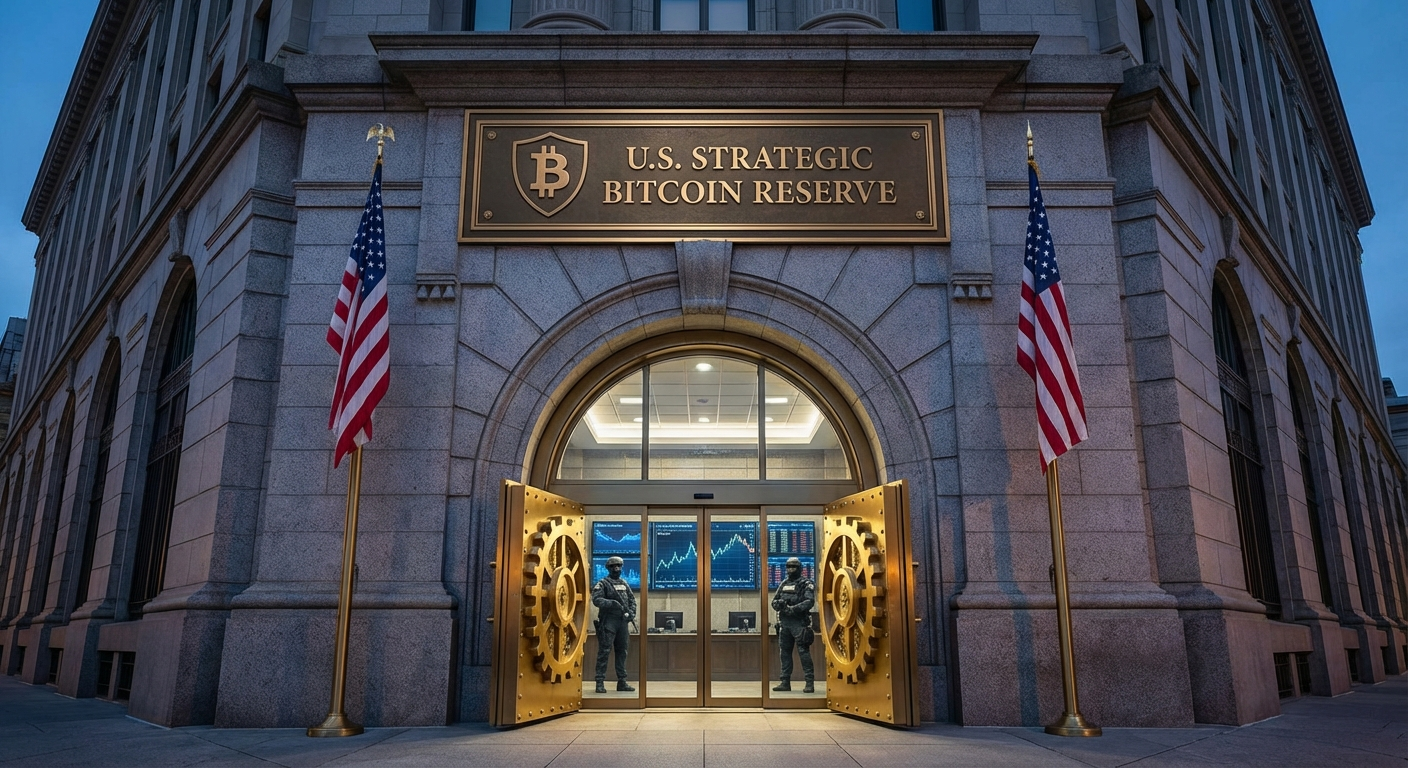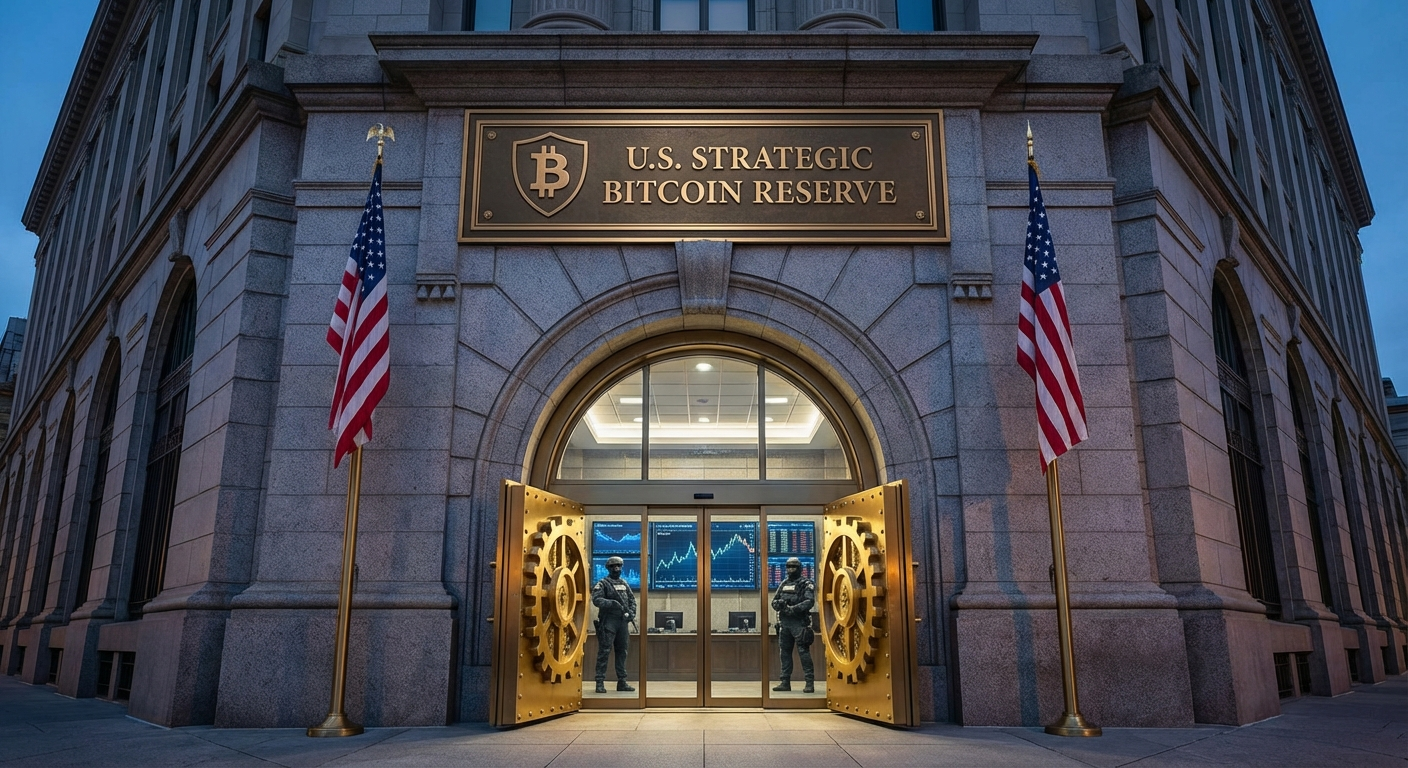
The United States has officially joined the sovereign Bitcoin race. Here’s what the Strategic Bitcoin Reserve means for crypto legitimacy, geopolitical competition, and the future of money.
Executive Summary
On March 6, 2025, President Donald Trump signed an executive order establishing the Strategic Bitcoin Reserve—a move that crypto czar David Sacks has called America’s “digital Fort Knox.” This watershed moment represents the first time a major Western power has officially designated Bitcoin as a strategic reserve asset, placing it alongside gold, oil, and foreign currency reserves in the nation’s financial arsenal.
The implications are staggering. With an estimated 200,000+ BTC in government coffers from criminal seizures and forfeitures, the United States now holds one of the largest institutional Bitcoin positions on Earth. And unlike previous government crypto holdings that were routinely auctioned off, this Bitcoin will never be sold.
This article examines what the Strategic Bitcoin Reserve means for Bitcoin’s legitimacy, the geopolitical race it has triggered, the legal complexities being worked out behind the scenes, and what investors should expect as we move deeper into 2026 and beyond.
What Is the Strategic Bitcoin Reserve?
The Strategic Bitcoin Reserve, established through executive order, represents a fundamental shift in how the United States views cryptocurrency. For the first time, the federal government has created a dedicated custodial framework specifically designed to hold Bitcoin as a long-term national asset.
According to the executive order itself:
“Bitcoin is the original cryptocurrency. The Bitcoin protocol permanently caps the total supply of bitcoin (BTC) at 21 million coins, and has never been hacked. As a result of its scarcity and security, Bitcoin is often referred to as ‘digital gold.’ Because there is a fixed supply of BTC, there is a strategic advantage to being among the first nations to create a strategic bitcoin reserve.”
This language is remarkable. The President of the United States has officially recognized Bitcoin’s core value propositions—its fixed supply, security track record, and “digital gold” properties—in a formal legal document. This isn’t a campaign speech or a social media post; it’s binding executive policy.
How the Reserve Works
The Secretary of the Treasury has been directed to establish an office that will:
- Administer and maintain control of custodial accounts collectively known as the Strategic Bitcoin Reserve2. Capitalize the reserve with all Bitcoin held by the Treasury Department that was forfeited through criminal or civil proceedings3. Consolidate holdings from other federal agencies, which have 30 days to review their authority to transfer government-held Bitcoin to the reserve4. Develop acquisition strategies for obtaining additional Bitcoin through budget-neutral means
The order also creates a separate “United States Digital Asset Stockpile” for non-Bitcoin cryptocurrencies, though this receives far less favorable treatment—the government will only acquire additional altcoins through seizures, not active purchasing.
The “Never Sell” Mandate
Perhaps the most significant provision in the entire executive order is this:
“Government BTC deposited into the Strategic Bitcoin Reserve shall not be sold and shall be maintained as reserve assets of the United States utilized to meet governmental objectives in accordance with applicable law.”
This single sentence fundamentally changes Bitcoin’s relationship with the U.S. government. Previously, seized Bitcoin was routinely auctioned by the U.S. Marshals Service, often at prices well below market value. The famous Silk Road auctions in 2014 saw the government sell 50,000 BTC—coins that would be worth billions today—to early investors like Tim Draper.
That era is over. Every Bitcoin that flows into government hands through law enforcement actions will now be locked away indefinitely.
The Fort Knox Comparison: Digital Gold Meets Physical Gold
When David Sacks, the administration’s AI and crypto czar, described the Strategic Bitcoin Reserve as a “digital Fort Knox,” he was making a deliberate comparison that resonates deeply with both crypto advocates and traditional finance.
Fort Knox: A Brief History
The United States Bullion Depository at Fort Knox, Kentucky, holds approximately 147.3 million troy ounces of gold—about half of the Treasury’s total gold reserves. Established in 1936, Fort Knox became a symbol of American financial power and stability. The gold stored there backs confidence in the U.S. dollar, even though the direct gold standard was abandoned in 1971.
Fort Knox gold is rarely accessed or audited. The last public visit was in 1974 when a Congressional delegation toured the facility. The gold simply sits there, a psychological and financial backstop that Americans (and the world) trust exists.
The Digital Parallel
The Strategic Bitcoin Reserve is being positioned as a 21st-century equivalent:
| Attribute | Fort Knox Gold | Strategic Bitcoin Reserve |
|---|---|---|
| Asset Type | Physical gold bars | Digital Bitcoin |
| Storage | Underground vault | Cryptographic wallets |
| Supply Cap | ~197,000 tons globally | 21 million BTC exactly |
| Portability | Extremely difficult | Instant global transfer |
| Verification | Requires physical audit | Publicly verifiable on blockchain |
| Seizure Risk | Can be physically confiscated | Requires private keys |
The comparison is instructive but imperfect. Gold has a 5,000-year track record as a store of value; Bitcoin has existed for only 17 years. However, Bitcoin advocates argue that the cryptocurrency’s mathematical scarcity makes it a “harder” asset than gold, which can always be mined in greater quantities as technology advances.
Current Holdings Estimate
While exact figures remain classified, estimates suggest the U.S. government holds between 200,000 and 250,000 BTC from various seizures over the years, including:
- Silk Road seizures (2013-2015): Originally over 170,000 BTC, though much was auctioned- Bitfinex hack recovery (2022): 94,000 BTC returned- Various dark web marketplace busts: Tens of thousands of additional coins- Individual criminal forfeitures: Ongoing seizures from fraud, ransomware, and tax evasion cases
At current prices hovering around $70,000 per Bitcoin, this represents approximately $14-17 billion in holdings. For context, U.S. gold reserves are valued at roughly $500 billion—Bitcoin still has catching up to do, but the foundational infrastructure is now in place.
Geopolitical Implications: The Sovereign Bitcoin Race
The United States is not acting in isolation. The Strategic Bitcoin Reserve must be understood within the context of accelerating global competition for digital asset supremacy.
The First-Mover Advantage
The executive order explicitly acknowledges what game theorists have long argued:
“Because there is a fixed supply of BTC, there is a strategic advantage to being among the first nations to create a strategic bitcoin reserve.”
This is a remarkable statement. The U.S. government is openly admitting that Bitcoin accumulation is a competitive, zero-sum dynamic. Every Bitcoin the United States holds is one that China, Russia, or any other nation cannot acquire at that price.
Which Nations Will Follow?
The Strategic Bitcoin Reserve creates enormous pressure on other countries to respond. Consider the calculus facing various nations:
Nations Likely to Establish Reserves:
- El Salvador: Already holds Bitcoin as legal tender and has been accumulating since 2021. May accelerate purchases.- United Arab Emirates: Dubai has positioned itself as a crypto hub. Sovereign wealth funds are rumored to hold Bitcoin.- Switzerland: The Swiss National Bank has faced repeated calls to add Bitcoin to reserves.- Singapore: A major crypto hub with sophisticated treasury operations.- Germany: Government holds 50,000 BTC from criminal seizures; may reconsider planned auctions.
Nations Facing Difficult Choices:
- China: Officially bans Bitcoin but reportedly holds substantial quantities from seizures. May establish “unofficial” reserves.- Russia: Under sanctions pressure, Bitcoin offers a potential sanctions-evasion tool. May accumulate secretly.- European Union: Fragmented approach—individual member states may act before EU-level policy emerges.
Nations Resistant to Adoption:
- Japan: Central bank has expressed skepticism; may remain on sidelines.- India: Has oscillated between bans and regulation; unlikely to adopt reserve strategy soon.
The Prisoner’s Dilemma
The game theory here is profound. If other nations don’t accumulate Bitcoin and the U.S. reserve appreciates significantly, they lose relative financial position. If they do accumulate and Bitcoin fails, they’ve wasted resources. If everyone accumulates, prices rise, validating early adopters.
The U.S. move essentially forces every treasury minister on Earth to form an opinion on Bitcoin. There is no more hiding behind “it’s too speculative” or “we’re still studying it.” The world’s largest economy has taken a position.
The Legal Labyrinth: “Obscure Provisions” and Implementation Challenges
While the executive order establishes the Strategic Bitcoin Reserve in principle, the actual implementation requires navigating a complex legal landscape that administration officials have described as involving “obscure legal provisions.”
Treasury Authority Questions
The Secretary of the Treasury has been given 60 days to deliver:
“An evaluation of the legal and investment considerations for establishing and managing the Strategic Bitcoin Reserve and United States Digital Asset Stockpile going forward, including the accounts in which the Strategic Bitcoin Reserve and United States Digital Asset Stockpile should be located and the need for any legislation to operationalize any aspect of this order.”
This language reveals uncertainty. The administration isn’t entirely sure which existing legal frameworks authorize a national Bitcoin reserve, or whether new legislation is required.
Key legal questions include:
- Which fund holds the Bitcoin? The Exchange Stabilization Fund? A new Treasury account? This matters for Congressional oversight.2. Custody arrangements: Who controls the private keys? What happens if a Treasury official goes rogue?3. Valuation and accounting: How does the government mark Bitcoin holdings? At cost? Market value? This affects budget calculations.4. Disposal authority: Even with a “never sell” mandate, what happens in a fiscal emergency?
Congressional Codification Efforts
Recognizing that executive orders can be reversed by future administrations, Representative Byron Donalds (R-FL) introduced legislation on March 14, 2025, to codify the Strategic Bitcoin Reserve into permanent law.
The Donalds bill would:
- Establish the Strategic Bitcoin Reserve as a statutory entity- Prohibit the sale of reserve Bitcoin without Congressional authorization- Create reporting requirements to the House Financial Services and Senate Banking committees- Define custody standards and audit procedures- Authorize (but not appropriate) funds for additional Bitcoin acquisition
The bill faces uncertain prospects. While Republicans generally support the reserve concept, some fiscal conservatives question whether the government should be “speculating” in volatile assets. Democrats have been largely skeptical, with some calling the reserve a “handout to crypto bros.”
Interagency Complications
The 30-day agency review period has revealed complications. Different federal agencies have acquired Bitcoin through different legal mechanisms:
- FBI/DOJ: Criminal asset forfeiture- IRS: Tax enforcement and seizures- SEC: Civil penalties and disgorgement- Treasury/OFAC: Sanctions enforcement- Homeland Security: Immigration and customs violations
Each agency has different statutory authorities governing asset disposition. Centralizing all Bitcoin into a single Treasury account may require agency-by-agency legal analysis and potentially legislative fixes.
Banking and Institutional Implications
The Strategic Bitcoin Reserve arrives amid a broader thaw in the relationship between traditional finance and cryptocurrency.
Banks Cleared to Hold Crypto
In a related regulatory shift, banking regulators have clarified that national banks and state-chartered banks may now custody cryptocurrency assets for customers. This reverses years of ambiguity that kept major financial institutions on the sidelines.
The implications are significant:
- JPMorgan, Bank of America, Wells Fargo and other major banks can now offer Bitcoin custody services- Institutional investors gain access to regulated custody solutions- The “crypto is too risky for banks” narrative collapses- Bitcoin integrates further into the traditional financial system
The Bitcoin ETF Ecosystem
The Strategic Bitcoin Reserve also validates the spot Bitcoin ETF products that launched in January 2024. If the U.S. government considers Bitcoin worthy of a strategic reserve, retail investors holding Bitcoin ETFs can feel more confident about their positions.
The major ETF issuers—BlackRock, Fidelity, Grayscale, and others—now manage over $100 billion in Bitcoin on behalf of investors. Combined with the government reserve, this represents a fundamental shift in Bitcoin’s ownership structure from retail speculators to institutions and sovereigns.
Corporate Treasury Adoption
Companies like MicroStrategy (now “Strategy”) have pioneered corporate Bitcoin treasury strategies. The government reserve provides political cover for other corporations to follow suit. CFOs can now point to federal policy when proposing Bitcoin allocations to their boards.
What This Means for Bitcoin and Crypto Legitimacy
The Strategic Bitcoin Reserve represents perhaps the most significant legitimacy milestone in Bitcoin’s history. Consider the progression:
2009-2013: Bitcoin exists primarily among cypherpunks and early adopters 2014-2017: Exchanges emerge, first institutional interest develops 2017-2020: ICO boom, mainstream awareness, but regulatory hostility 2020-2023: Corporate adoption (Tesla, MicroStrategy), regulatory clarity begins 2024: Spot Bitcoin ETFs approved 2025: U.S. government establishes Strategic Bitcoin Reserve
Each step has progressively normalized Bitcoin. But government endorsement hits differently. When the same entity that prints the dollar decides to hold Bitcoin, it sends an unmistakable signal: Bitcoin is here to stay.
The “Regulatory Capture” Critique
Critics argue that the crypto industry has achieved “regulatory capture”—using political donations and lobbying to convert regulators from adversaries to allies. The Strategic Bitcoin Reserve, they contend, represents the ultimate capture: making the government itself a stakeholder in Bitcoin’s success.
There’s merit to this critique. Officials who oversee Bitcoin policy now have an institutional interest in Bitcoin appreciating. This creates conflicts of interest that will require careful management.
The Validation Effect
For the broader crypto ecosystem, the reserve validates core narratives:
- Scarcity matters: The government is accumulating a fixed-supply asset- Security matters: The government trusts Bitcoin’s protocol security- Sovereignty matters: Self-custody and decentralization provide value even to states- Digital assets are real assets: Bitcoin receives treatment equivalent to gold
This validation effect may benefit the entire crypto market, though Bitcoin’s specific designation suggests a preference for the original cryptocurrency over newer alternatives.
Looking Ahead: 2026 and Beyond
As we move through 2026 and beyond, several developments bear watching:
Near-Term (2026)
- Treasury report delivery: The 60-day evaluation should reveal implementation details- Congressional action: The Donalds bill and potential alternatives will move through committee- Other nations respond: Expect announcements from at least 2-3 other countries- Market effects: Reduced supply from government sales may tighten market dynamics
Medium-Term (2027-2028)
- Potential active acquisition: If budget-neutral strategies are developed, the government may begin purchasing Bitcoin- 2028 election implications: The reserve becomes a political issue—future administrations may expand or attempt to liquidate- Bitcoin halving (2028): The fourth halving reduces miner rewards to 1.5625 BTC per block, potentially driving prices higher
Long-Term (2029+)
- Sovereign Bitcoin standard: If multiple nations hold reserves, a new de facto monetary order may emerge- Dollar relationship: Bitcoin may complement or compete with dollar hegemony- Generational shift: Voters who grew up with Bitcoin will shape future policy
Conclusion: A New Chapter in Monetary History
The establishment of America’s Strategic Bitcoin Reserve marks a turning point that future historians may regard as the moment Bitcoin achieved mainstream institutional status. By declaring that the United States “will not sell any Bitcoin deposited into the Reserve,” the government has aligned its interests with Bitcoin’s long-term success.
For investors, this reduces certain tail risks. The probability that the U.S. government launches an aggressive crackdown on Bitcoin has diminished substantially—you don’t attack your own reserve assets. For the crypto industry, it provides legitimacy that no amount of marketing could purchase. For the global financial system, it introduces a new variable into the already-complex dynamics of monetary competition.
The “digital Fort Knox” is real. Whether it ultimately proves as durable as its gold-filled predecessor in Kentucky remains to be seen. But one thing is certain: the conversation about Bitcoin has fundamentally changed. It’s no longer a question of whether governments will engage with cryptocurrency. They already have.
The only questions now are how much, how fast, and who will accumulate the most before the next halving.
Key Takeaways
- The Strategic Bitcoin Reserve was established by executive order on March 6, 2025, creating a government Bitcoin custody framework- Government Bitcoin will not be sold, ending the practice of auctioning seized cryptocurrency- Approximately 200,000+ BTC are estimated to be in government hands from various seizures- Rep. Byron Donalds introduced legislation to codify the reserve into permanent law- Banks are now cleared to custody crypto assets, integrating Bitcoin into traditional finance- Other nations face pressure to establish their own reserves or risk falling behind- Legal complexities remain, with Treasury evaluating implementation within 60 days- The 2028 halving and 2028 election will shape the reserve’s future trajectory
This analysis is for informational purposes only and does not constitute investment advice. Cryptocurrency investments carry significant risks including potential loss of principal.